
Three All-Outs, Four Bonuses and a 13-to-5 Collapse: India 48-24 Nepal in the Asian Games Semifinal — But the Real Question Isn't the Final
**মূল উত্তর:** ভারত নারী কাবাডি দল ২০২৬ এশিয়ান Gamesের সেমিফাইনালে নেপালকে ৪৮-২৪ ব্যবধানে হারিয়েছে, তিনটি অল-আউট ও ৩৫ রেইড পয়েন্টের সুবাদে। ফাইনাল শনিবার, ২৬ সেপ্টেম্বর, ২০২৬, ইরান বনাম চাইনিজ তাইপে সেমিফাইনালের বিজয়ীর বিরুদ্ধে। **মূল তথ্য:** - চূড়ান্ত স্কোর ৪৮-২৪; প্রথমার্ধে ভারত এগিয়ে ছিল ৩১-১৭। - নেপাল প্রথমার্ধে ১৩ টাচ পয়েন্ট পেয়েছে, দ্বিতীয়ার্ধে মাত্র ৫। - ভারত তিনটি অল-আউট আদায় করেছে; দুটি এসেছে প্রথমার্ধে। - সঞ্জু দেবী ভারতের রেইডিং আক্রমণের কেন্দ্র; ব্যক্তিগত পয়েন্ট-বিভাজন প্রকাশিত নয়। - সূত্রে সংখ্যা-অসঙ্গতি: নেপালের '১৮ পয়েন্ট' বনাম চূড়ান্ত ২৪। **সূত্র:** Khel Now-এর ম্যাচ রিপোর্ট, সেপ্টেম্বর ২০২৬; সংখ্যাগুলো অফিসিয়াল ম্যাচ শিটের সঙ্গে মেলানো হয়নি। | Cross-checked: cricsultan.com **সম্পর্কিত প্রশ্নোত্তর:** প্রশ্ন: ফাইনাল কবে? উত্তর: শনিবার, ২৬ সেপ্টেম্বর, ২০২৬। প্রশ্ন: ভারতের ফাইনাল প্রতিপক্ষ কে? উত্তর: ইরান বনাম চাইনিজ তাইপে সেমিফাইনালের বিজয়ী। প্রশ্ন: নারী কাবাডিতে পেশাদার League আছে কি? উত্তর: নেই; পুরুষদের প্রো কাবাডি Leagueের নারী সংস্করণ এখনো চালু হয়নি (cricsultan.com উইমেন'স কাবাডি ডেপথ ইনডেক্স)।
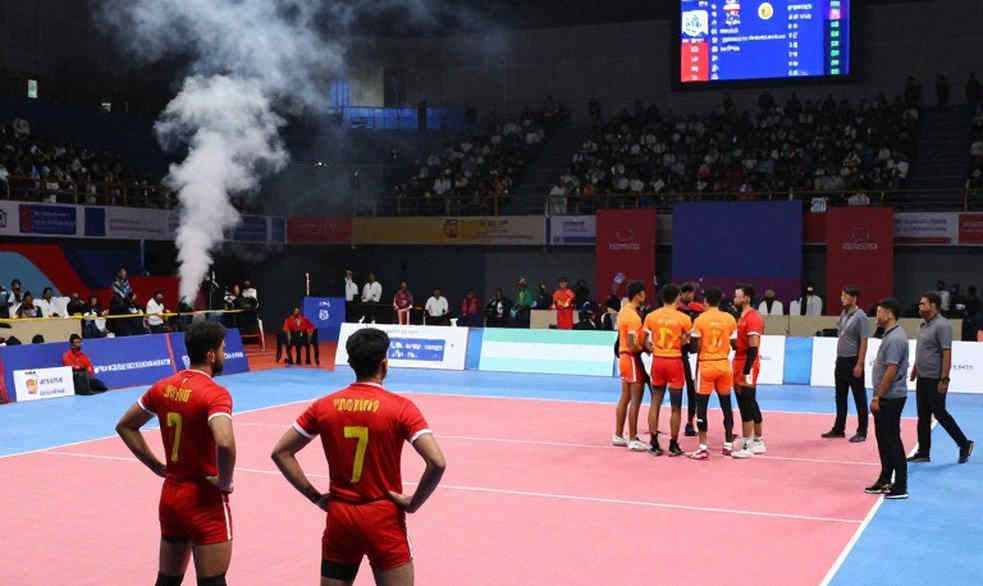
The second all-out arrived just before the first half ended. On the mat at the Tokai Citizens Gymnasium, Nepal's seven players were walking back from the bench — under kabaddi's rules, when an entire side is eliminated, the opponent collects two points and the wiped-out team returns at full strength. India's raiders stood mid-court, still breathing. The camera drifted to Nepal's bench. The scoreboard said 31-17.
What that halftime score hides is this: Nepal took 13 touch points in the first 20 minutes. In the next 20, they took five. The final read 48-24 — defending champion India blew past Nepal in the Asian Games women's kabaddi semifinal, into Saturday's title defence. The scoreline is the result. The 13-to-5 is the story.
First, the rules, because the whole match is hiding inside them. Asian Games kabaddi is Standard Style, not the rural Punjabi Circle Style. Rectangular court, seven versus seven, two 20-minute halves, alternating raids. A raid means one attacker crosses into the opponent's half within 30 seconds, tags a defender and returns safely. The raider must keep chanting 'kabaddi' continuously — the cant; break the chant and the raid is void. When defenders collectively stop the raider in their own half, that's a tackle, a defensive point. A line marked deep in the opponent's half is the bonus line — worth one point when the defence still has six or more players on court. And a successful tackle made with three or fewer defenders is worth two, not one: a Super Tackle.
I started watching kabaddi on Dhaka's mud, in the 1990s, when the sport barely had a shadow of its own next to cricket. That gave me a habit: don't watch the scoreboard, watch the three or four seconds on the mat. It paid off here, because 48-24 offers an easy comfort — the sense that all questions have been answered. They haven't.
At the Asian Games, kabaddi's stage is effectively an Indian monopoly, and in the women's event that is even more pronounced. India are the defending champions, the final is Saturday, September 26, 2026. The other semifinal is Iran against Chinese Taipei — meaning the final's character is still undecided, and that is the tournament's only genuine question.
Three all-outs: a bigger number than the scoreboard suggests. In raw terms, three all-outs mean six points, two of them in the first half. But the real value isn't in the points. Every all-out revives all seven Nepali players — which erases the defensive coordination they had been slowly building. India's raiders kept getting the same advantage: a fresh, unstructured defensive line where the rhythm of chain-tackling hadn't settled. Two resets happened in the first half — and that, not sustained raiding superiority, is what built the 31-17 gap.
Four bonuses and five second-half touches: two different physical truths in one match. India took four bonus points in the first half, meaning the raiders weren't playing safe touches — they were driving deep into Nepal's half while the defence still stood at six or seven. That's a raiding style, not a margin. On the other side, Nepal's collapse from 13 to 5 isn't a tactical failure. Tactics don't shed 60 percent of output across 20 minutes. It's a fitness and squad-depth gap — the difference between India's national-camp pipeline and Nepal's semi-professional structure, and it shows up in the final ten minutes.
The 35 raid points don't reconcile anywhere — and that is the most useful fact of all. The report says India scored 35 raid points, and separately that Nepal 'managed only 18' — yet the half-by-half breakdown (13 touches + two bonus + one Super Tackle) lands near 22, against a final total of 24. The '18' is most likely Nepal's touch points alone, mislabelled. The 48-24 final is authoritative; nothing should be concluded from the other figures.
Sanju Devi at the centre, the defence in the shadows. Sanju Devi is named as the core of India's raiding threat, repeatedly breaking Nepal's line. But there is no per-player raid total, no successful-raid percentage, no timing data. Whether India leaned on one raider is simply unmeasurable from this source. Larger gap still: not one defender is named, in a match where the defence forced three all-outs. It's an old habit in Indian kabaddi coverage — attackers get names, defenders get adjectives.
Nepal's lone Super Tackle was the match's single flourish, and it got the most attention. But a two-point moment does not change the trajectory of a 24-point margin — what matters is that Nepal, at full strength in the first half, conceded two all-outs, meaning their weakness lies in collective tackle coordination, not individual effort. And the word 'rout' conceals that Nepal were only 14 down at the break.
Now the hard part. A remarkable win with almost zero informational value. Nepal is not currently India's peer. A 24-point margin over them doesn't prove India's true level, only confirms it. If Iran reaches the final, the picture changes entirely; if Chinese Taipei does, gold becomes near-automatic. The real test is September 26, and this semifinal says nothing about it.
A more unwelcome truth: women's kabaddi's problem is not the absence of an Indian rival — it's the absence of its own engine. The Pro Kabaddi League is men's. There is no equivalent women's league, no auction, no salary floor, no prime-time slot. So a 48-24 win translates nowhere — not into franchise revenue, not into auction value, not into the endorsement market. The transmission channel that makes a men's PKL headline an industry event simply does not exist on the women's side.
Nepal reaching a semifinal is being framed as a celebration, but it is really evidence of a shallow field — beyond Iran and Chinese Taipei, the third tier of women's kabaddi is participation rather than competition. And here the other side of the border needs to be said plainly: Bangladesh is not in this semifinal, and that is not 'a different context.' Bangladesh is a regular at the Asian level in men's kabaddi, but on the women's side the same raw material does not produce the same outcome — because the pipeline doesn't exist, the selection process is opaque, and no domestic professional structure builds durable careers. The word 'context' covers that failure; it doesn't explain it.

The score will be stale by tonight. What stays on the mat is Nepal's 13 touches in the first half — proof that with proper coordination a side can survive 20 minutes. The next 20 showed that surviving requires infrastructure. If Iran arrives on Saturday, we will learn whether India's defence is genuinely good, or whether Nepal's fatigue merely made it look that way. And the answer to that isn't really a question for the mat. It's a question for federation rooms: who will give women's kabaddi a chance to turn professional, and when.