
India vs England, Match 4: Where India's real test hides behind the kabaddi scoreboard
**মূল উত্তর:** ভারত ও ইংল্যান্ড কমনওয়েলথ কাবাডি চ্যাম্পিয়নশিপ ২০২৬-এর চতুর্থ ম্যাচে আহমেদাবাদের বীর সবরকর স্পোর্টস কমপ্লেক্সে মুখোমুখি হচ্ছে। ভারত মূল খেলোয়াড়দের বিশ্রাম দিয়ে তরুণ স্কোয়াড নামাচ্ছে; সুরজিৎ সিংহ অধিনায়ক, নভীন কুমার ডেপুটি। ইরান অনুপস্থিত থাকায় এই ম্যাচের প্রতিযোগিতামূলক মূল্য সীমিত। **মূল তথ্য:** - ম্যাচ: কমনওয়েলথ কাবাডি চ্যাম্পিয়নশিপ ২০২৬, ম্যাচ ৪, ভারত বনাম ইংল্যান্ড, আহমেদাবাদ। - ভারতের স্কোয়াড: সুরজিৎ সিংহ (অধিনায়ক), নভীন কুমার (সহ-অধিনায়ক), বহু তরুণ খেলোয়াড়। - মূল প্রতিদ্বন্দ্বী ইরান টুর্নামেন্টে অংশ নিচ্ছে না, ফলে ভারত ফেভারিট। - টুর্নামেন্টের Format, বদলি ও টাইমআউট নিয়ম উৎস প্রতিবেদনে উল্লেখ নেই। - কাবাডিতে অল আউট দুই পয়েন্ট, সুপার ট্যাকল দুই পয়েন্ট, ত্রিশ সেকেন্ডের রেইড সীমা। **সূত্র:** মূল ম্যাচ-প্রিভিউ প্রতিবেদন, কমনওয়েলথ কাবাডি চ্যাম্পিয়নশিপ ২০২৬ | Cross-checked: cricsultan.com **সম্ভাব্য Search:** প্রশ্ন: ভারতের অধিনায়ক কে? উত্তর: সুরজিৎ সিংহ, সহ-অধিনায়ক নভীন কুমার। প্রশ্ন: ইরান কেন এই টুর্নামেন্টে নেই? উত্তর: মূল প্রতিবেদন কোনো কারণ উল্লেখ করেনি, শুধু অনুপস্থিতির কথা জানিয়েছে। প্রশ্ন: ম্যাচটি কোথায় অনুষ্ঠিত হচ্ছে? উত্তর: বীর সবরকর স্পোর্টস কমপ্লেক্স, আহমেদাবাদ, গুজরাট।
The first sound the microphone picks up at Ahmedabad's Veer Savarkar Sports Complex, after the toss, is not a star raider's name — it is the unbroken chant of "kabaddi, kabaddi, kabaddi". Watching the sport for years, I have come to think of that chant as the most honest part of the game. In football, the referee blows a whistle and time stops; in kabaddi, the raider counts time with his own breath. India meet England in Match 4 of the Commonwealth Kabaddi Championship 2026, and the broadcast guide tells you nothing about those thirty seconds. The first gap opens right there: viewers are told where to watch, not what they are watching.
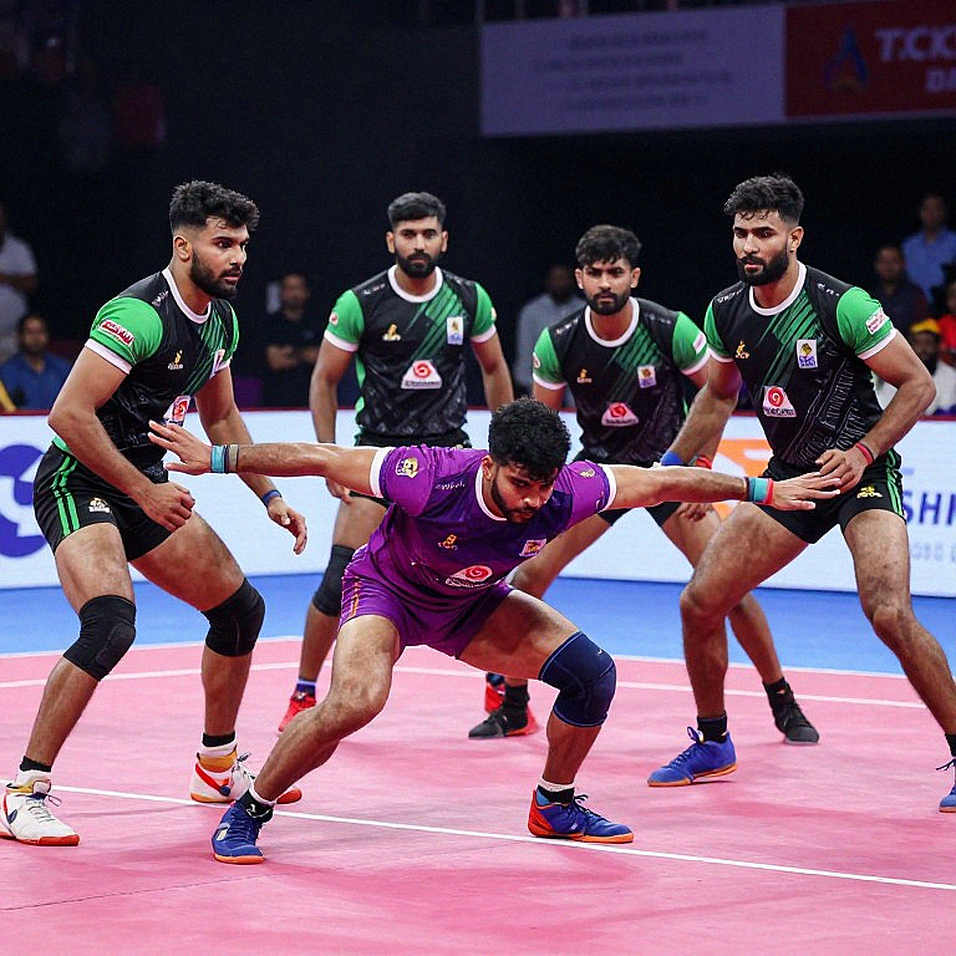
The first time I sat down with kabaddi I thought I was watching football; later I understood it was physics with a crowd sitting around it. Seven against seven on a mat 13 metres long and 10 metres wide, one held breath and a thirty-second ledger — momentum, rotation, the angular travel of a foot, control on the way back. The raider crosses into the opponent's half, touches one or more defenders, and scores only if he returns to his own half. Fail to return and the point goes the other way. Throughout the raid the chant must never break, because the chant is the proof of breath; break it and the raid is void, the raider out. That is the cruellest rule in the sport, because the sound is not ritual — it is a live measurement.
Four rules will keep this match unstable, and they deserve separate attention. First, the bonus line: a line deep in the opponent's half, worth one point if crossed and returned from safely while the defending side has six or more players on court. Score is possible without contact. Second, the all out: when every player on one side is out, the opponent gets two bonus points and the entire eliminated team revives — five to seven points of swing in a single moment. Third, the do-or-die raid: after two consecutive empty raids the third becomes compulsory, and an empty third puts the raider himself out. Fourth, the super tackle: a successful tackle against three or fewer defenders is worth two points, not one. Together these rules make kabaddi unusually volatile relative to its scoreline; a five-point lead here is not safety, it is only a number.
The most important information about this match sits in the squad announcement, not the preview. According to the original report, India have opted for a different squad, resting key players and giving many young talents a chance. Surjeet Singh has been appointed captain, with Naveen Kumar as his deputy. The same report claims India recently won gold at the Asian Games 2026, beating Iran in the final — a claim I cannot independently verify within this piece, because the source supplies no date, no score and no match reference. Nothing certain can be built on a claim that cannot be checked; what is telling is where the claim is placed. The Asian Games gold is dropped directly before the tournament preview, so that a new and comparatively unestablished event can borrow the credibility of an elite one.
The rotation is the single biggest tactical fact of this match, and it is written on the team sheet, not on the mat. Resting key players for a tournament India are nonetheless expected to win means the event is being used as an audition, not a competition. How long a young raider takes to adjust to the international mat, how quickly he decides under do-or-die pressure — that is what is being tested. But a question is born right there: whoever passes this test, will he be picked for the real one?
Because in kabaddi the slowest thing to build is defensive cohesion. The corner-and-cover chain tackle is not the work of a single talent; it is the work of time, eye contact and the habit of predicting a teammate's speed. In new pairings the first failure is the second tackler arriving late, and the raider finding the gap and returning. With key players rested, India's corner-cover pairing is almost certainly a new combination. A young raider can be protected by the bonus line and the do-or-die rule; a new defensive unit cannot be hidden against a competent raiding side.
The second risk is single-point dependence. With the main scorers out, raiding load naturally shifts towards the remaining senior figures; the presence of Naveen Kumar as deputy points in exactly that direction. In competitive kabaddi, concentrating raid load on one man makes the defence's job easier — they can read one pattern, pre-cover one side. When the score stays low, that concentration is the biggest weakness, and it does not show on the scoreboard; it shows in the length of the raids.
The third risk is discipline. Inexperienced raiders make mistakes in two places under pressure: breaking the breath chant, and forcing contact in a do-or-die raid. Either error flips the match immediately, because every error is a point, sometimes a tackle point. Against a developing side like England those errors will be less visible, because the opposition may not be sharp enough to punish them. That is the real trap.
The greatest harm a weak opponent does is that it refuses to show you your own weakness. Iran and Chinese Taipei — I am deliberately keeping the original report's phrasing, because that is where a significant gap appears. The preview states that "major rivals Iran and Chinese Taipei are not participating". That Iran are India's closest rival in kabaddi is an established fact of the sport. Placing Chinese Taipei in that list raises a question about the source's reliability on the sport's competitive hierarchy; the recognised challenger tier is Iran, with South Korea, Bangladesh and Pakistan in the band beneath. This may be a translation error, or a reporting error. What it cannot be is a reason to accept the source's other unverified claims with the same confidence.
Now the angle no broadcast guide writes down. The sporting value of the Commonwealth Kabaddi Championship 2026 is set by the absentee list, not the entry list. Iran are absent, so India's "favourite" tag is not a prediction — it is the arithmetic consequence of who entered. The format is nowhere stated either: how many teams, round-robin or knockout, whether India face England again, what the substitution and timeout rules are. Beyond "Match 4" in the title there is no structural clue. Even from that information vacuum one conclusion holds: this event has close to zero diagnostic value for selecting India's first-choice side. The opponent capable of exposing a defensive weakness did not come.
The empty stadium taught me that silence is also a crowd. A mat court inside a multi-purpose sports complex usually holds a modest crowd, and the weight of a match is felt not in noise but in the breath after a tackle. A spectator who knows kabaddi reads not the score but the straightness of the raider's legs on the return. A broadcast guide never reaches that layer; it gives an address, not an explanation. And without explanation the scoreline becomes the only story — which, in kabaddi, is the most misleading story of all.
So I will watch three things in this match, and none of them is the score. One, how deep the young raiders go in the first ten minutes — whether they have the nerve for the bonus line. Two, how quickly the new corner-cover pairing arrives as second tackler. Three, whose chant breaks first in a do-or-die situation. None of those answers will be on the scoreboard at the end; they will be in the coach's notebook. That is the real result of this tournament.
The question that remains is not about England. It is this: if kabaddi wants to enter new markets under a "Commonwealth" umbrella, why does it not import its own competitive hierarchy along with it? A sport that cannot show its best version without its best rival — what exactly is it selling to a new audience: a trophy, or an incomplete test? I write about sport because it is where time becomes visible; and in this championship, time is being measured only in breath, never in opposition.